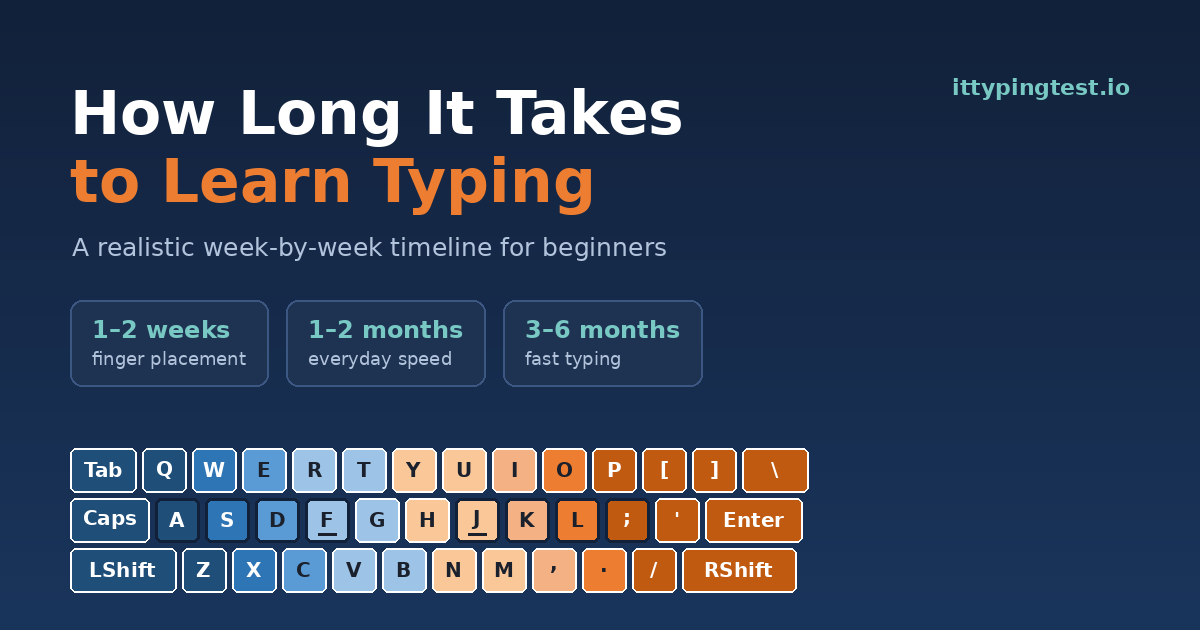
Almost everyone who sits down to learn touch typing asks the same thing on day one: how long is this going to take? It is a fair question. Hunting for keys with two fingers works, sort of, and giving that up feels risky when you have emails to send and assignments due.
The Short Answer: How Long It Takes to Learn Typing


Typing speed climbs quickly in the first two months, then slows into steady gains.
What “Learning to Type” Actually Means

Each finger owns a small group of keys. The home row is where every movement starts and ends.
• Placement – knowing that your left index finger owns F and your right index finger owns J. This is pure memorisation and it goes fast.
• Accuracy – hitting the right key without correcting yourself. This takes a few weeks of patient, slow practice.
• Speed – doing all of the above without conscious thought. This is the long part.
Skipping straight to speed is the classic mistake. Errors cost far more time than slow typing does, because every mistake means noticing it, reaching for backspace, and retyping. Researchers who studied 136 million keystrokes found that error corrections are one of the biggest drags on overall typing speed, with the average person hitting backspace more than twice per sentence (Aalto University).
Slow and clean beats fast and messy. Every time.
How Long It Takes to Learn Typing Based on Daily Practice
Practice time is the single biggest factor. Here is roughly how different routines play out for someone starting from scratch and aiming for a comfortable 50 WPM.


More practice helps, but the returns flatten out after about half an hour a day.
Short and frequent beats long and rare. Three focused 15-minute sessions across a week will do more for you than one exhausting two-hour session on a Sunday. Your fingers are learning a motor pattern, and motor patterns need repetition spread over time, not crammed into one sitting.
Factors That Change How Long It Takes to Learn Typing
Two people can follow the same course and finish months apart. Here is why.

That last point about posture matters more than it sounds. OSHA recommends keeping your hands, wrists and forearms straight and roughly parallel to the floor, with shoulders relaxed (OSHA computer workstation guidance). Sore wrists are the number one reason people abandon typing practice in month two.
An 8-Week Plan to Learn Typing
If you want a structure to follow, this one works for most beginners at 20–25 minutes a day.

A simple eight-week route from the home row to a solid 40 WPM.

Take a timed test at the end of every week and write the number down. Progress in typing is invisible day to day and obvious week to week. Running your weekly check on a free online typing test keeps the measurement consistent, which matters more than the tool you pick.
Mistakes That Make It Take Longer
Looking at the keyboard. Even a quick glance resets the habit you are trying to build. Cover your hands with a light cloth if you must.
Chasing speed too early. If your accuracy is under 95%, speed practice is wasted practice.
Practising only random words. Drills are useful at the start, but real sentences teach your fingers the letter combinations you will actually use.
Skipping the awkward keys. Everyone avoids Q, Z and the number row. Those become your permanent weak spots if you let them.
Stopping the moment it feels comfortable. Weeks four to six are where speed really compounds. Most people quit right before the payoff.
How to Tell You Are Actually Improving
Speed alone is a noisy measure. Watch these instead:
• Accuracy – aim for 95% or higher before pushing pace.
• Backspace use – fewer corrections means real progress.
• Rhythm – smooth, even keystrokes beat bursts and pauses.
• Eyes – how long can you go without glancing down?
One interesting finding from the Aalto keystroke study is that fast typists overlap their keystrokes, pressing the next key before fully releasing the last. You cannot force this. It appears on its own once the movements become automatic, which is a good sign you are past the hard part.
Comments
Comments are reviewed before they appear.
No comments yet — be the first to share your thoughts.