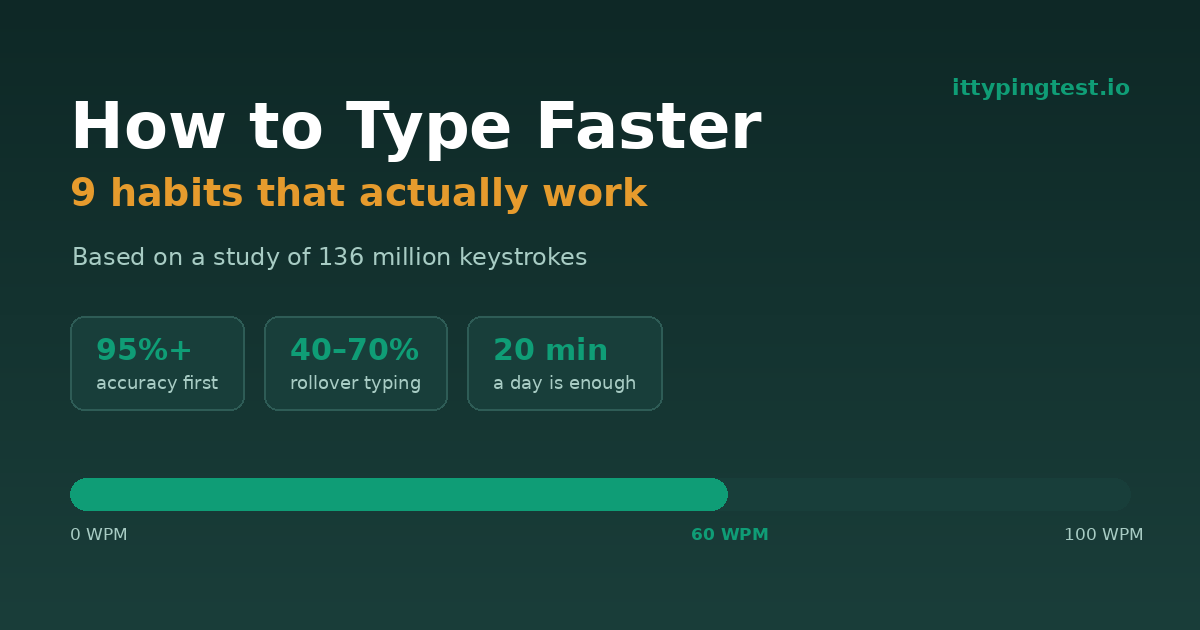
How to Type Faster: 9 Habits That Actually Work
Most advice on how to type faster boils down to “practise more.” That is true and completely useless. You already know practice helps. What you want to know is which twenty minutes of practice moves the needle and which twenty minutes are wasted.
The good news is that this has actually been studied. Researchers at Aalto University and the University of Cambridge analysed 136 million keystrokes from 168,000 people (read the study), and what separates fast typists from slow ones turned out to be surprisingly specific. It is not finger strength or expensive keyboards. It is errors, rhythm, and a few habits you can start fixing today.
Here is what works.
Where You Stand Right Now
Before changing anything, get a number. The Aalto data found that most computer users land somewhere between 30 and 60 words per minute, while a small group pushes past 120.

Test yourself on the ITTypingTest homepage and write the number down. You cannot tell whether any of this is working without a starting point. If you are still learning the basics, start with our guide on how long it takes to learn typing first, then come back to this one.
1. Fix Your Accuracy Before Your Speed
This is the big one, and almost everyone gets it backwards.
Every mistake costs you three separate things: noticing it, reaching for backspace, and retyping the word. That is far more expensive than simply typing a little slower in the first place. The Cambridge team put it plainly:
Slow down to avoid them and you will be faster in the long run.
The researchers found that faster typists simply make fewer mistakes. Not “make mistakes and fix them quickly.” Make fewer.

A 60 WPM typist at 90% accuracy is effectively slower than a careful 40 WPM typist.
If your accuracy is under 95%, speed drills are actively wasting your time. Drop your pace by about 20% until the errors stop, then let the speed come back on its own. It will, and it will come back higher than where you started.
2. Learn to Alternate Hands
Here is a finding almost nobody talks about. The study found that letter pairs typed by different hands or fingers predict typing speed better than things like repeated letters do.

Words that bounce between hands are fast. Words that pile onto one hand are slow.
In plain English: words that bounce between your left and right hand are fast. Words that pile onto one hand are slow. Compare “the” (left, right, left) with “pump” (right hand for almost all of it). One flows, the other stumbles.
You cannot change English spelling, but you can notice which words trip you up and drill those specifically. Most people have about a dozen personal problem words. Fixing those is worth more than a hundred generic drills.
3. Let Rollover Happen
Fast typists press the next key before fully releasing the last one. It is called rollover typing, and the fastest typists in the study used it for somewhere between 40 and 70 percent of their keystrokes.
You cannot force this. Trying to consciously overlap your keystrokes just produces mistakes. It shows up naturally once a letter combination becomes automatic, which is why practising real words and sentences beats practising random letters. Random drills never let combinations become automatic because they never repeat.
How to Type Faster: The Habits That Slow You Down

Most people have at least three of these. Pick the one that stings the most and fix that first.
4. Stop Looking at the Keyboard
Every glance down breaks your rhythm and resets the muscle memory you are trying to build. It feels faster in the moment and is slower over any period longer than a minute.
If you cannot resist, drape a light cloth over your hands. Awkward for a week, permanent gain afterwards.
5. Sit Properly
This sounds like filler advice until your wrists start aching in week three and you quit. OSHA recommends keeping your hands, wrists, and forearms in a straight line roughly parallel to the floor, with your shoulders relaxed and elbows close to your body.
Fatigue does not just hurt. It makes you sloppy, and sloppy means errors, and errors are the thing costing you speed in the first place.
6. Practise Real Text, Not Nonsense
Random letter drills are useful for maybe two weeks when you are learning key positions. After that they stop helping, because the letter combinations never repeat often enough to become automatic.
Type actual paragraphs. Articles, emails, book excerpts, anything with normal English word patterns. Your fingers need to learn “tion” and “ing” and “the” as single movements, not as three or four separate keypresses.
7. Use Both Shift Keys
An enormous number of otherwise-decent typists use only the left Shift key. That means the left hand is doing the shift and reaching for letters on its own side, which is exactly the one-hand pile-up that slows people down.
Rule: capital on the left side of the keyboard, use the right Shift. Capital on the right side, use the left Shift. It feels wrong for about three days.
8. Learn the Shortcuts That Save Whole Seconds
Raw WPM is only part of real-world speed. Every trip to the mouse costs you roughly a second, and most people make hundreds of those trips a day.

Ctrl+Backspace alone is worth learning today. Deleting a whole word at once instead of holding backspace and watching letters disappear is a noticeable difference.
9. Practise in Short, Frequent Sessions
Twenty minutes a day beats two hours on a Sunday, every single time. Motor learning needs repetition spread across days, not crammed into one sitting. Once you pass roughly half an hour in a session, fatigue starts introducing errors and you begin practising your mistakes.
Here is a four-week routine that works:

Interestingly, the researchers also found that people who had taken a formal typing course at some point typed at broadly similar speeds to people who never had. Formal training matters less than what you do consistently.
How Long Before You See Results?
If you currently type around 40 WPM and follow the habits above for twenty minutes a day, expect roughly 10 extra WPM in six to eight weeks. Gains get slower at every level. Going from 30 to 40 is quick. Going from 70 to 80 can take months.
Retest yourself weekly on the same typing test so the numbers stay comparable, and track accuracy alongside speed. A jump from 45 to 52 WPM means nothing if your accuracy fell from 97% to 89%.
Comments
Comments are reviewed before they appear.
No comments yet — be the first to share your thoughts.